KWAAYMII CULTURAL CENTER
HISTORIES OF SIGNIFICANT INDIVIDUALS
Legacy of the Kwaaymii.
"This is where they lived and where they died and where they still live on, as far as memory is concerned," Carmen said. "They should not be forgotten." Carmen Lucas, 2004.

KWAAYMII; PEOPLE RIGHT HERE
Naming is an act of power. Scripture informs us that naming is the first recorded act of dominion. Thus, naming is assigning the symbol of identity.  The one who assigns is the insider.  Similarly the first response, to another or others is to assign a name..
 
Mastamho said: "Some of you are outside, east of the house, I want you to be the Hamapaivek. Some of you are outdoors west of the house, I will call you Hamivevek. You people just west of the door, I will call Hamitsanvek.
You just inside the door, near these last, I call Hamiavek. 
You people near the fire here, not against the wall, I call you Hamahavek.
He called them by these names, but all the people did not answer.  They did not say, "Yes, we will be called that." All of them said nothing. 

Then Mastmho said again, "This time I will call you who you are on the east, Havalyipai." 
Then those people called that name easily, and all those indoors said, "Now they are the Walapai." 

Then he said again: "Those will be the Yavapai also.  I want them to live near each other in the mountains." 
Those are the ones that first he had called Hamapaivek. 

Then he said again: "Those outdoors on the west, whom at first I called Hamivevek, I now call Tsimuveve.  All say that!" Then all said: "Chemehuevi." 

He said again: "Those just inside the door on the west of it I called Hamitsanvek. Now I called Hamiaivek, I now call Kamia, You will live near each other. 

Then he said: "I have made you all to be tribes, Walapai, Yavapai, Chemehuevi, Quechan, and Kamia, you are all different.  I spoke the name Hamahavek.  Now I call them Hamakhave. All will call you that, you Mohave, and you will know them by that name." 

In the morning Mastamho went outside.  He wanted a place to put the people outdoors.  He said: "Tonight some of you will become tribes and some of you will become birds.  I will tell you about that tonight, but not during the day." 

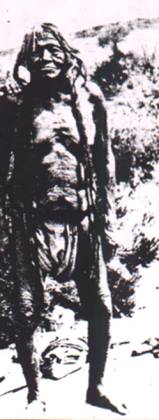
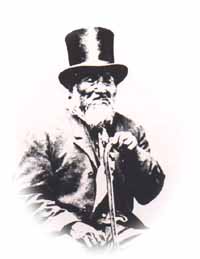
MAI TA KWAS (Yellow sky) is a historical Native American from the turn of the 20th century. He was documented and photographed by the Mesa Grade resident and prominent ethnographer Edward H. Davis.

Yellow Sky's father was Kwaaymii and his mother was Quechan (Yuma). Yellow Sky traveled back and forth to the Colorado River area every spring. He returned to stay on the Laguna Reservation in 1888. He had a small dwelling just north of the still existing Tom Lucas' cabin on the main Kwaaymii village. In his later years SuSaana Klietch, Tom's grandmother, would often take care of him. He would still travel via access to the traditional trails of the Ipai and Tipai communities that are along and around the Cuyamaca mountain region. He was frequently recalled by non-Indian observers as one of the last true traditional living individuals wearing only basic regalia.

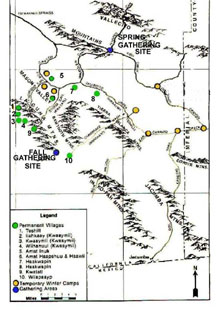
Yellow Sky was acknowledged during a recent Wildcat song practice session and according to Jon Mesa Cuero, "This song was composed in 1848 or 1849. It presents the impressions of the composer starting a journey North from Tecate in the Sun wise circle of the Tipai villages. Yellow Sky was a man who was very slender and tall." (One of the physical characteristics of the River people, especially the Quechan, is their height. Many are well over six and a half feet.) Thus, according to Jon, "This man was so tall he could have painted the sky. This is why he was called, in Tipai: Mai Ta Quas, "Pinta el Cielo Amarillo" Paints the Sky Yellow"- Yellow Sky. (Song ) A further association with the Kwaimii is the Nymii Wilcat song the makes direct reference to the southern village site Ewiiaapaay or Cuyapaipe. Refer to village map for song clip and location. (Click map to enlarge and hear clip.)
See the Nymii, Wildcat page for more on this song style.

WA AMAAY KWAKAS (Yellow sky) is a historical Native American from the turn of the 20th century. He was documented and photographed by the Mesa Grade resident and prominent ethnographer Edward H. Davis.

Jon is a native speaker of Tipai and is knowledgeable of the distinctions between the different dialects of the Tipai language. In fact there are many subtleties beyond the documented variations between Ipai and Tipai. It is not unusual to find a variation in spelling or grammar that the particular Band is very comfortable with but may give headaches to linguists.
See the Nymii, Wildcat page
for more on this song style.

The timeless quality of the songs and stories carry the Tribal culture from the timeless past into the yet unknown future. As such the chronological dates in many of the traditional Native American stories are fluid. This brings to mind another insight into the oral tradition and the richness of Native American literature. Jon once told us that his father taught him this same song about Ewiiaapaay over fifty years ago when he was a child. As the years went by and he became an adult and caught up in the day-to-day efforts to provide for a family he had less of a grasp of those songs he had been taught as a boy. 'Old' Sam Brown from Viejas/Los Conejos reminded him about the Ewiiaapaay story. As he was repeating the words the tune to the song emerged and he was able to place this Ewiiaapaay song in a sequence of village/Band geography. Recall and talent are major influences on each storyteller's ability to bring the event to life. Fluid almost as much as the inspiration that sparks the humanity and glow in our heart to share: thoughts, emotion, joy, sadness and historical events.

In those later years when Yellow Sky got too old to make the trip to the Colorado river, he would visit the other local Laguna and North county mountain reservations: Mesa Grade, Inyaja, Cosmit, Santa Ysabel, Mataguyay, San Felipe, Ewiiaapaay or Cuyapaipe, Manzanita, Campo and maybe even Los Conejos and El Capitan-Barona reservation. Ed Davis, an early photographer, wrote an account of his acquaintance with Yellow Sky in the publication Indians of the Southwest United States and Northwest Mexico.

In 1915, 28 years after Davis settled in Mesa Grande, a representative of the Museum of the American Indian, Heye Foundation, made his way up the mountain to inspect the collection. After negotiations, he purchased almost the entire collection for the museum.

Also in 1915, perhaps with the funds from the sale of his collection, Davis built Powam Lodge, a resort hotel with an all-Indian motif. The lodge soon became popular, attracting visitors to the clear air of the mesa and the opportunity to hear its proprietor, a talented storyteller, regale the guests with accounts of his experiences among the Indian people of the Southwest. Davis encouraged local Kumeyaay artisans to make traditional items of quality to sell at Powam Lodge, and often hired Indian performers.

A 1916 meeting in San Diego with George G. Heye, the founder and director of the Museum of the American Indian, resulted in Davis accepting an offer to be a field collector of ethnological specimens for the museum. He was delighted. In a 1931 article he wrote for Touring Topics, Davis recalled, "This gave me the very job I had long hoped to create for myself". It began a relationship with George Heye and his museum that lasted, intermittently, for seventeen years. Historical aside: The New York Heye Collection was a large core collection for the most recent National Museum of the American Indian in Washington D. C.

  Kwaamii, Kamia, Comeya, Kumeyaay, (Bureau of American Ethnology Bulletin 30) or any of the collective 15 or so variations of names the Kwaamii village tribal people have been synonymously linked with Diegueno.  Since the late 1960s the terms, in popular politically correct usage are Native American, Kumeyaay. (Not all tribal people have been pleased with the changes.) Just what bands / tribes it included from San Diego eastward to the lower Rio Colorado can be best understood if based on the oral tradition and traditional song cycle geographical / celestial orientation.
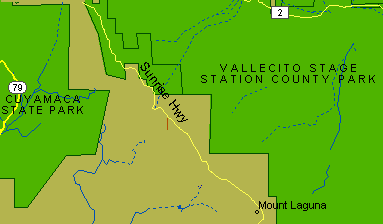
     What western history has documented is that Kwaamii is the name for one of ten village / band locations. It was utilized by the Ipai-Tipai linguistically associated tribal people of the Cuyamaca, Mount Laguna location. In addition to the recorded ten village sites, there are well recognized summer and seasonal locations within their geographical area.
(See map for reference)
     When visited by Anza, Garces, and Font, in 1775, the "Quemada" wore sandals of maguey fiber and descended from their own territory (which began at the Cuyamaca mountains, lat 33* 08' some 100 miles to the mouth of New River in N.E. Baja California). 
     Politically, the Kwaamii Kumeyaay sovereignty is historically defined by aboriginal land title and reinforced by the original 1851 treaties with the United States of America.  The Kumeyaay and Kwaamii Village are a federation of autonomous, self-governing bands with clearly defined territories that include individual and collective properties of families. These bands function by self determined governmental procedures utilizing the 1934 Indian Reorganization Act, Tribal Council, State or Federal corporation, and a traditional 'Custom and Tradition' political organization.


They live life as a song. Songs celebrate, mourn, teach and pass on history and social values. Songs contain the collective wisdom of the people. Singing serves both the people and the land well. The people planted, burned and still keep the land beautiful, healthy, and thriving for thousands of years. They traditionally unite in defense of their territory (a recent example is the Proposition Five issue of Tribal Sovereignty and not gambling as it is often misunderstood to be) and have a courier system for communicating information throughout their lands. (Viejas: F. Shipek) 
     A band's territory extends anywhere from 10 to 30 miles along a stream and tributaries. 
It includes trails for all members, general hunting, religious, ceremonial and common areas. 

Generally peaceful by nature, the Kwaamii custom and tradition is distinguished by tolerance and individual freedom
SUSAANA KLIETCH
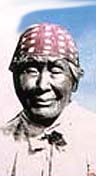
Study the character of SuSaana Klietch. . Visualize the delight and laughter those smile lines experienced. Imagine a life over 120 years. A life of wonder. A life of tradition. A life surrounded by the beauty of the Creator's world. Confident in her ability to pray. SuSaana is Kwaimii and known to us from early accounts. She lived in a time of pressure, change and tragedy. The qualities of endurance are written in her entirety. SuSaana is Kwaimii tradition.
The women bring forth life. Women nurture and sustain our heritage. "Ask your Mother." This is a constant thought we hear throughout life. "Women know, they just know." Also speaks to the sustaining role tribal women fulfill.
SuSaana was Mother to two daughters. One, passed on, the other is Maria Alto. SuSaana's husband is Pedro Pamay. They lived their lives in a traditional Kwaimii culture. She was a singer, known for this ability far and wide among Kumeyaay people. Further, she was often sought out for her knowledge of botanicals and medicine. SuSaana is reported to have be gifted in her ability to diagnose illness with song and rhythm. Her acts of responsibility and generosity demonstrate traditional Kwaimii hospitality. We cherish the memory of Susanna Klietch and the beauty of her association.    By Roy Cook


SuSaana 

Klietch


BRIEF HISTORY OF EFFORTS TO RETAIN TRIBAL LANDS

'THE KUMEYAAY INDIANS'

Interesting bits of information about the area:
JOSE MANUEL HATAM
Respected Indian leader from a 
band inhabiting present day Balboa Park 

In the Spring Valley area, Judge Augustus S. Ensworth hired Indians to work his spread. Ensworth paid his Indian employees a dollar a day. Ironically, Ensworth had built his adobe ranch house in the center of the recently abandoned Tipai (Kumeyyay) village of Neti or Meti. 
This important village was a leader in the 1775 attack on Mission San Diego de Alcala. 
Further south in National City, Charles Kimball, the founder of National City, noted in his diary of 1877 that he had hired two Indian laborers for ten dollars a piece per month plus board

Jane Dumas - D Q Language Course
WHAT IS THE REAL NAME FOR THIS PLACE ?   Click here to continue 
   
In the old days, of course, speakers of 'Iipay had their own names for the various places around San Diego. A lot of these have been  forgotten now,
but here are a few of the ones that people still remember. (Look at the maps
to see where they are.)

Quite a few place names around San Diego are of Kumeyyay origin.
La Jolla - This is probably from the Tipai word for "hole" or "cave" Ilehup. 
In one dialect the name for La Jolla would be MAT KALLUP "place of caves".  But in another dialect of Tipai, it is MAT KULAAHUUY which
is closer to the modern name.


Mission Gorge  'Ewiiykaakap ("goes around the rock ")

It is true that until 1900 and 1910 many Kumeyyay Indians had lived  in
Mission Valley and in various places around San Diego. A favorite spot
was between 13th and 17th around K Street. Other Indian living areas were:
on the bay at the foot of Fifth Street, along the Silver Strand, at the foot of Rose Canyon, along Ocean Beach, around the edge of Mission Bay
(False Bay), and all up and down Mission Valley.  Each of these locations has been corroborated independently by non-Indian "old timers" in San Diego.

During this same period of time, in addition to the Indians on the reservations of  San Diego County, there were off reservation Indians camped throughout Lakeside, El Cajon, Monte Vista, Jamacha, Otay, and all the little mountain valleys of the San Diego back country, like Descanso and Guatay
The older ranchers of the region have confirmed the stories concerning the residence of the Indians.

By 1910 the non-Indian populations of San Diego were increasing and filling Mission Valley with small farms and the city area with houses and business. The Indians gradually moved out of the coastal regions


Learn to Speak IPAI - Kumeyaay  Kumeyaay Language Course

FOR INFORMATION ABOUT EDUCATIONAL MATERIALS SUCH AS BOOKS, TAPES OR VIDEOS, ETC. OR TO RESPOND TO ANY OF THE INFORMATION PRESENTED HERE
YOU ARE ENCOURAGED TO LEAVE A MESSAGE FOR ROY COOK AT AISOURCE