By Roy Cook
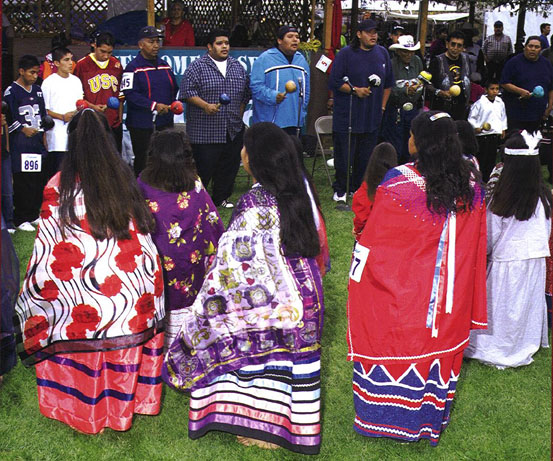
Sycuan Tribal land
is the focus of this three-day gathering of traditional Yuman singing
and dance. The Sycuan people hosted visitors and friends to their fourteenth
annual Pow wow. This weekend is a blessing from the Creator. All we can
desire and need and enjoy was evident in the company of the of the most
beautiful people in the world, Tribal People. All around the arena we
see: Children smiling in play, Grandparents being protective and instructive
to all children. Also, most evident, the women are always first in tribal
country. In attendance are: Anna Sandoval, former Chairperson of Sycuan
Band of Kumeyaay, Jane Dumas from Jamul Band of Kumeyaay, they are sitting
together with Vickie Gambala, San Diego Indian Education. These ladies
carry the culture, as they nurture the future of the people, our Indian
Children.
Glorious days and cool evenings, a most magnificent moon shining brighter
each night on the finest people of this Turtle Island. Indian people proudly
gathering in their traditional ways and reflecting the changes and contributions
of other Indian nations. This Native American diversity continues to empower
us.
The Pow wow grounds
reflected the care and respect the Sycuan people and the Pow wow committee,
led by Arlene Galvin, devoted to the event. The grassy arena was a joy
to dance on. I was pleased to join the head gourd  dancer,
Don Vigneualt in the first gourd dance session, on Friday evening. Tribal
Warriors, grouping together, recognize each other gruffly. I suppose it
is too evident that males so often appear to be boys in grownups clothes.
Maybe it is the military training or the circumstances of being in harms
way. In any case it is good to see these Veterans here in the sun for
all the people to recognize. There were fine songs sung this first evening
session of gourd dance. The singing was announced to be an open Gourd
dance drum, expanded and led by the host southern drum. This would be
just a prelude to the three-day offering of around the clock singing.
dancer,
Don Vigneualt in the first gourd dance session, on Friday evening. Tribal
Warriors, grouping together, recognize each other gruffly. I suppose it
is too evident that males so often appear to be boys in grownups clothes.
Maybe it is the military training or the circumstances of being in harms
way. In any case it is good to see these Veterans here in the sun for
all the people to recognize. There were fine songs sung this first evening
session of gourd dance. The singing was announced to be an open Gourd
dance drum, expanded and led by the host southern drum. This would be
just a prelude to the three-day offering of around the clock singing.
Yuman song very often
is generally labeled Bird songs. There are from 12 to 14 variations of
the Yuman song style. Yuman
or Bird Song singers are a vital element in the Kumeyaay custom and tradition
within the local Native American social structure. Bird Singers occupy
responsible roles. Traditionally, early in life, potential singers are
introduced to established lead singers. During these associations young
singers are evaluated to determine: commitment, capacity to learn, and
qualities essential to group singing as opposed to individual performance.
Essentially,
the Yuman or Bird songs are a series of epic song cycles in the oral tradition.
These songs also fulfill a social role as entertainment and many times
are sung just for the joy of the occasion. Further, these Bird songs may
also be sung as a Kumeyaay Traditional Community presentation. At these
occasions protocol is formally defined and one must get up and dance when
the proper song is sung.
There are regional
variations in Yuman song but essentially the lead singer and helpers or
singers begin standing or seated in a row. After a series of songs, variable
to the occasion, the lead singer will rise and dance forward in a series
of small steps. Then they will dance backward until they contact the seats
or close proximity to the starting point.
A facing row of dancers
will often assemble, mostly female, and guided by the gourd rattle and
song join in the presentation. The dancing is often inspiring to the moment
and lead singer.
So often I
have over heard comments on Bird Singing from observers to the culture,
“They all sound alike." also "They just go back and forth, over and over."
Yet to the informed observer, these songs are a sweet sophistication of
multiple related songs. The singer may or may not elect to bring out double
step, or triple step songs, spins, turns.
Ron Christman, Bird singer, is the announcer for the Yuman song and dance completion. This long time resident of the Viejas reservation is often called upon to establish the proper orientation. He has long been a good supporter of local Native American events and especially, from the very beginning, the first Sycuan Pow wow.
Peon songs are sung in the evening into the early hours of the morning. Often youth groups form into teams and start early in the evening and the adult trams competing organize and warm up well after midnight.
"Peon" is a highly competitive game of complex strategy, skill and calculation. It is played with eight players - four on each side, with an additional man or woman to act as umpire (Koymi). The two sides are usually made up of male or female players from different tribes or bands. The object of the game is for one side to win all the tally sticks.
Much betting accompanies the game among both the men and the women. The game may be won in a short time, or it may - as frequently happens - prolong itself through an entire night, until the early morning, with several hundred dollars changing hands!
How Peon is played: Someone will select a smooth vacant place and build a small fire and spread his blanket and sit down. He will then holler "pe-own-e." No one seems to pay any attention to him. By and by, he will again holler "Pe-own-e." Then perhaps someone will come and sit down with him and hold his blanket on his lap. Eventually a couple more players will come until there is a full team on each side. There seems to be no hurry. Each side has a blanket. Support singers or friends and family from each team - or band -will come and stand behind the players while the game is in progress and sing the "Peon Songs" as the game is in progress. The songs have meaning and tell a story. They also set the mood for the game.
Tally Sticks:
The Koymi, or referee, man or woman, by the fire (at the head of the two
lines of players) has fifteen tally sticks which are divided between the
two sides - seven to one side and eight to the other.
These sticks
are about fourteen inches long, and a quarter of an inch in diameter,
having either the tip or sometimes the entire length painted in red, or
in decorative designs. Peon Sticks or bones: The game itself is played
with eight "peon sticks"- four white, and four black (usually made of
sheep bone or coyote bone). They are about three inches long and a quarter
of an inch in diameter.
Each Peon stick/bone
has a hole through the center with a string drawn through. The string
is slipped over the wrist in a slip noose, the object being to prevent
any possibility of trickery when the call comes to "show" (by shifting
the stick from one hand to the other).
The Play:
When all the players are ready to begin the game the end players take
up the blanket, and hold it in their teeth. Behind each blanket, the players
slip the noose over their wrists, holding the stick in their hands, which
they then conceal under the armpits.
The players
chosen to do the guessing must then guess in which hand the white or black
stick is concealed. When he or she has made up their mind they clap their
hands and point to where they have decided the black or white stick should
be. At the same time calling out their decision to the Koymi, or referee.
The Koymi,
at the end awards tally sticks corresponding to the number of correct
guesses from one side to the other. The game is won when one side wins
all of the tally sticks.
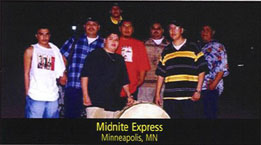
The Host Northern Drum, Midnight Express sang northern songs. They are from Minneapolis, Minnesota. They have been traveling from coast to coast and have produced a CD in cooperation with the Head Southern drum.
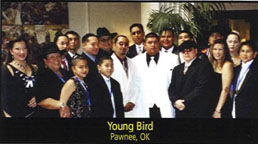
The very popular, Young Bird Singers from Pawnee, Oklahoma filled the arena with Southern plains song.
Veterans, memorial, flag songs and Entry songs were sung in rotation by many of the Drums in the singing completion. Selections were determined by the Pow wow committee in a sincere effort to be fair and allow each group an opportunity to sing.
Beautiful regalia, feathers flying, ribbons flashing in the sun, beadwork sparkling in complex designs. Tribal tradition is visible in each smile and proud glance, everywhere in glorious splendor. Many friends, familiar faces, all of us a little older but still enjoying our Indian ways. May these songs bring you good health and safe travel back to your homes.
Songs echoed in the
Sycuan canyons of time immemorial. Calling to all our relations: Here
we are once again, we are what you taught us, we are what has been, and
will continue to be, Indian people.
Thanks to the Creator for the time to be here together again. Mehan, A
ho, thank you.
All uncredited images
taken from of Event Program
americanindiansouurce.com
Roy Cook: writer,
public relations, speaker
Opata/Osage-Mazopioye Wichasha